
While the West Asia conflict has led to a drop in patient footfalls, hospitals are seeing higher realisations as international patients increasingly travel for complex, high-end procedures.

Prime Minister Narendra Modi lauded India's 7.8 per cent GDP growth, achieved despite global conflicts and instability. He emphasised the importance of Swadeshi and self-reliance for a developed India by its 100th year of Independence, urging citizens to avoid unnecessary foreign expenditures.

Navigating this geopolitical minefield requires a cold-blooded blend of immediate tactical pleading, structural domestic diversification, and aggressive collective resistance, suggests Ambassador Rajasekhar.

Russian President Vladimir Putin has arrived in India for a three-day visit to attend the BRICS summit and hold bilateral talks with Prime Minister Narendra Modi, focusing on expanding trade, investment, and energy cooperation amidst global geopolitical challenges.

India's foreign exchange reserves increased by USD 964 million to USD 675.157 billion in the week ending July 10, according to the Reserve Bank of India.

Iran's Supreme Leader Mojtaba Khamenei will not attend his father, former Supreme Leader Ali Khamenei's, funeral due to security concerns stemming from Israeli threats. This decision follows a sharp warning from Iran's Foreign Minister to the United States, urging it to control Israel after its Defence Minister reportedly marked Khamenei for death. The incident highlights escalating tensions and ongoing diplomatic efforts to de-escalate hostilities in West Asia.

India is set to host five-time world champions Brazil in a historic invitational football friendly in Kolkata. The match, while offering invaluable exposure for the Indian team, has also drawn criticism over its cost and the decision to withdraw from the FIFA ASEAN Cup. The event carries political significance and marks a key step in Brazil's rebuilding process.

Five-time world champions Brazil are set to play India in an invitational friendly at Kolkata's Salt Lake Stadium, marking their first-ever international meeting. The match, while a spectacle for Indian fans, has drawn criticism regarding its cost and impact on Indian football development, with former captain Bhaichung Bhutia questioning its value over long-term investment. For Brazil, it's part of a rebuilding process, while India aims to gain invaluable experience against a top-tier team.

Indian benchmark indices Sensex and Nifty surged in early trade, with the Sensex jumping nearly 700 points, primarily driven by strong buying in IT stocks following TCS's positive June-quarter results and optimistic demand outlook. Track Sensex, Nifty on July 10, 2026.

Hyundai Motor India is set to outpace the broader passenger vehicle market, projecting an 8-10 per cent domestic sales growth in H2FY27, fueled by strategic launches of a new mid-size SUV and a dedicated electric vehicle, alongside increased production capacity.
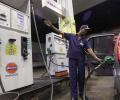
Despite international crude oil prices falling to a four-month low, retail petrol and diesel prices in India are unlikely to be cut immediately because state-run refiners are still processing costlier crude purchased during the peak of the West Asia crisis, Oil Minister Hardeep Singh Puri said.
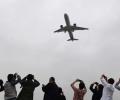
India witnessed the highest increase in airfares among the 10 top aviation markets in the Asia-Pacific and West Asia collectively across both domestic and international flights Q4 2019 and Q4 2022 in nominal terms, according to research by Hong Kong-based Airports Council International (ACI). India, where fares went up by 41 per cent, was followed by the UAE (34 per cent), Singapore (30 (per cent) and Australia (23 per cent). The study, which was undertaken in collaboration with Flare Aviation Consulting, examined around 36,000 routes in the top 10 aviation markets in Asia-Pacific and West Asia.

Leading appliance and consumer electronics manufacturers are set to increase prices of air conditioners, LED TVs, washing machines, and other products by 5 to 8 per cent from October 1, citing rising input costs for metals like copper and steel, crude derivatives, and currency exchange volatility due to the West Asia crisis.

Non-resident Indians (NRIs) in the Gulf region are increasingly purchasing term life insurance policies from India, driven by geopolitical uncertainties in West Asia and the significant cost advantages offered by Indian products, with the GCC region now contributing over half of the total NRI demand.

The successful hosting of the 18th BRICS summit in New Delhi has provided a significant boost to the BJP, offering a timely opportunity to strengthen its narrative against the opposition ahead of crucial assembly elections next year. BJP sources highlight the BRICS grouping's strong condemnation of the Pahalgam terror attack and the consensus declaration as major diplomatic victories for the Modi government, countering criticisms of its foreign policy. The party plans to leverage these outcomes during its month-long Seva Sankalp campaign to connect with various sections of society.

Luxury hotels in Delhi are experiencing a significant room crunch and a sharp increase in tariffs ahead of the BRICS Summit. Many marquee properties show no availability or are quoting rates exceeding six figures per night around the September 12-13 event, highlighting a gap in India's hospitality infrastructure.

Herambh Karmarkar, a 30-year-old marine engineer from Pune, was killed in an attack on a Cyprus-flagged commercial vessel off Oman's coast amidst the West Asia conflict, with his family now awaiting the return of his mortal remains.

Bajaj Auto, the sole player in India's CNG-powered motorcycle segment, has seen a dramatic drop in registrations for its Freedom 125 CNG bike, from a peak of 12,167 in November 2024 to just 1,211 in May this year, primarily due to reduced price arbitrage between petrol and CNG and growing availability challenges.

State-owned refiners Bharat Petroleum Corporation Ltd (BPCL) and Hindustan Petroleum Corporation Ltd (HPCL) have reported substantial losses for the first quarter of financial year 2026-27 (Q1FY27), primarily driven by a sharp increase in crude oil prices exacerbated by the ongoing West Asia crisis and suppressed marketing margins on petroleum products.

Tata Motors Passenger Vehicles (TMPV) reported Q1FY27 results showing significant margin pressures at both Jaguar Land Rover (JLR) and its domestic operations, despite strong volume growth in the India business. Analysts expect these margin headwinds to persist, potentially offsetting gains from increased sales and new launches.
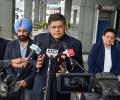
'It is high time that the 'war on terror' is removed from our diplomatic toolbox.' 'Certainly, our parliamentarians have no role in it,' asserts Ambassador M K Bhadrakumar.

'We may be able to wind back some of the schedule reductions we'd taken in recent months.'

External Affairs Minister S Jaishankar and his Iranian counterpart Abbas Araghchi held talks focusing on the West Asia crisis and its impact on energy supplies and maritime stability.

Accel's early investment in RentoMojo, a furniture and appliance rental platform, has paid off handsomely with the company's strong debut on the stock exchanges, listing nearly 19 per cent above its issue price after a significantly oversubscribed IPO.

China sailed through the crisis in the Strait of Hormuz relatively unscathed even as the impact of its steps shielded other consuming nations from having to pay high crude oil prices.

Akasa Air, despite facing headwinds from the West Asia conflict and rising aviation turbine fuel prices, expects to maintain a 30-40 per cent growth trajectory over the next five years and aims for an initial public offering (IPO) within two to four years, according to CFO Ankur Goel.

Supreme Leader Mojtaba Khamenei has reshuffled Iran's political and national-security establishment, appointing former SNSC Secretary Mohammad Bagher Zolghadr as his political adviser and veteran IRGC commander Mohsen Rezaei as his representative on the Supreme National Security Council, consolidating power amid the West Asia crisis and Strait of Hormuz tensions.
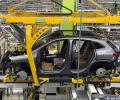
Domestic passenger vehicle dispatches in India reached a record 12,73,811 units in the first quarter of FY27, marking a 25.9 per cent growth, driven by robust domestic demand despite geopolitical headwinds, according to SIAM.

A proposed deal between Iran and Oman could grant Tehran control over vessels entering the Gulf through the Strait of Hormuz, according to a senior Iranian source and two regional officials who spoke to Reuters on Wednesday, in what represents one of the most significant concessions made to Iran to date.

'...as we believe with the adoption of AI, our IT services companies' revenue models will have to undergo a reset, which may in turn impact their potential for earnings growth.'

India has voiced deep concern over a drone attack targeting the Barakah nuclear facility in the United Arab Emirates (UAE), calling it a dangerous escalation in the West Asia conflict.

The Nomad Games, a biannual tournament of traditional nomadic sports, has drawn over 3,000 athletes from more than 100 countries to Kyrgyzstan, including many from Western nations keen to experience ancient Central Asian traditions like horseback archery and Kok Boru.

India has once again raised alarms over the escalation in the security situation in the Red Sea area and strongly condemned Houthi strikes targeting Saudi Arabian territory, "including on civilians and economic assets."

Prime Minister Narendra Modi on Thursday discussed with a group of senior ministers the prevailing global security situation and how to maintain supply chain uninterrupted despite conflicts in different zones, including the Strait of Hormuz, the Black Sea, the Red Sea, and the Gulf of Aden.

US Vice President JD Vance has postponed his visit to Switzerland for technical talks with Iranian negotiators, citing logistical issues. These negotiations are crucial for finalising the details of a recently signed peace deal between the US and Iran, which aims to end the conflict in West Asia and includes a 60-day period for technical discussions.

Cognizant reported a 1.4 per cent year-on-year dip in net profit for the April-June quarter to $636 million, while revenue grew 4.5 per cent to $5.5 billion. The company has also cut the top end of its annual guidance, citing a slowdown in macroeconomic conditions and rising uncertainty.

Pakistan, Saudi Arabia and Turkiye on Friday signed a key joint defence agreement under which an attack against one of them will be treated as an attack against all of them, amid increasing security concerns in the wake of escalating tensions in West Asia.

Indian information technology (IT) stocks, led by Infosys, experienced a significant selloff, dragging the Nifty to a two-month low, primarily due to escalating West Asian tensions pushing crude oil prices higher, and concerns over upcoming large IPOs diverting funds from secondary markets. The sector is also grappling with the long-term implications of AI disruption.

A vessel carrying 20,000 metric tonnes of Liquefied Petroleum Gas (LPG) arrived at Deendayal Port Authority in Kandla, Gujarat, after crossing the Strait of Hormuz amid the West Asia crisis.

India's fertiliser ministry has introduced a new analytical tool and a national-to-retail dashboard to monitor fertiliser dispatches, movement, and inventories in real time, aiming to prevent localised shortages and ensure equitable access for farmers.
